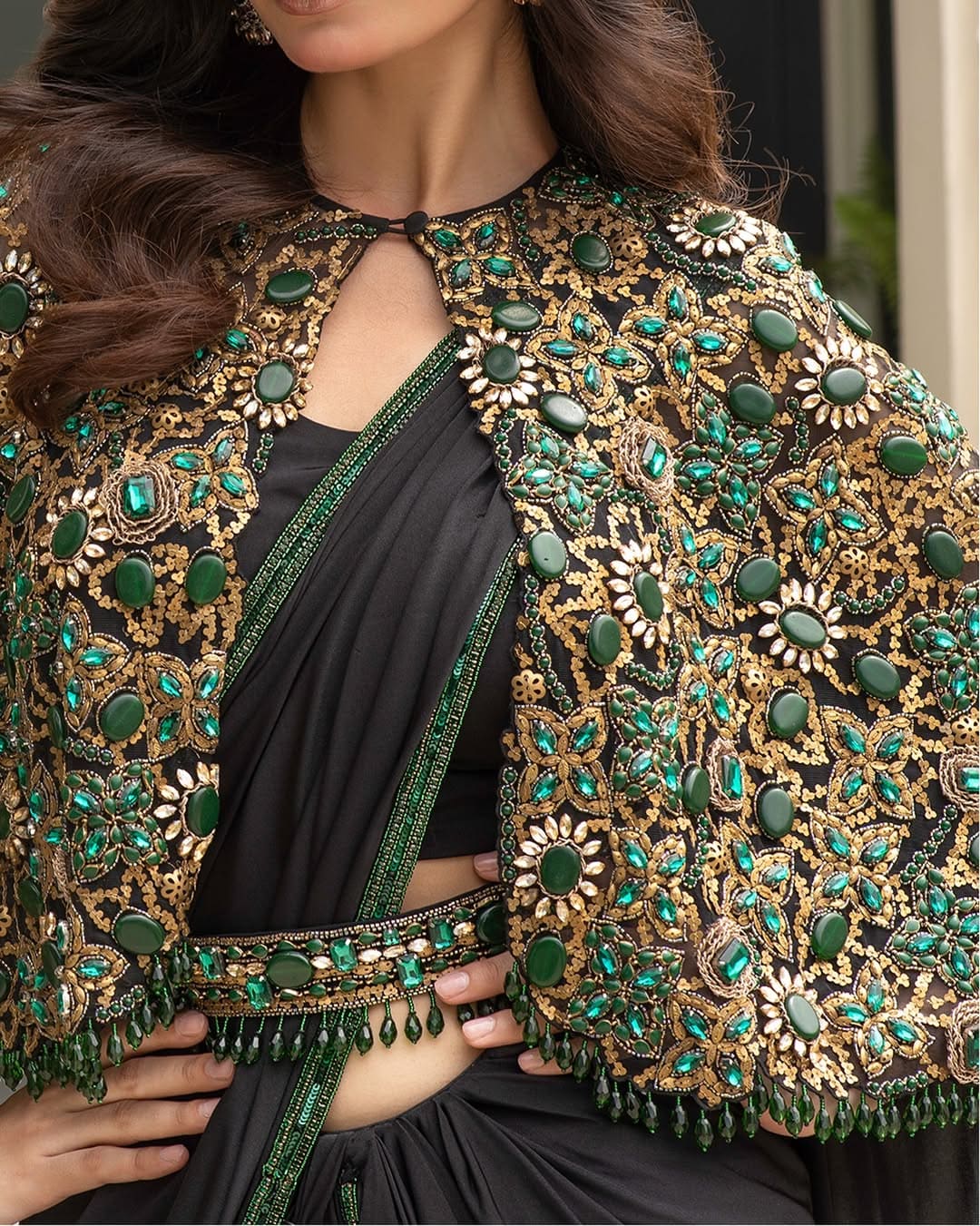

Saree, sari, kaftan, lehenga: the words get used interchangeably online and they are not the same garment. Whether you have an Indian or Pakistani wedding invitation in hand, or you grew up around these clothes and were never actually taught the difference, or you are just working out what to order, this guide answers the four questions people type into a search bar, one at a time, with no assumed knowledge.
What Is a Saree?
A saree is a single length of unstitched fabric, most often six yards long, draped around the body over a drawstring underskirt called a petticoat and a cropped, fitted top called a blouse. The petticoat is an A-line skirt with a tie waist rather than a fitted one, because the pleats have to be tucked into that waistband. Lengths run from about five and a half yards up to nine; six yards is the everyday standard, which is why the house collection is called Six Yards of Grace, and the nine-yard sarees exist for the regional drapes that use the extra fabric. No cutting or stitching happens to the main length of fabric itself; only the blouse and petticoat worn underneath it are sewn to fit.
At Rashmi Kumari, a saree supplied with a separate blouse has that blouse cut to your own measurements at no extra cost, because the blouse is the one part that has to fit like clothing rather than fall like fabric. Not every piece is built that way. One-piece, pre-draped and corset constructions, such as the Emerald Green Beaded One-Piece Saree, the Crimson Off-Shoulder Saree Dress and the Metallic Corset Saree, have no separate blouse at all; those are cut to your measurements throughout. Each product page says which construction you are looking at.
Sarees are worn across India, Pakistan, Bangladesh, Sri Lanka and Nepal, and the word is spelled two ways in English, saree and sari, for the same garment. The traditional wedding weaves carry the names of the places that make them: Banarasi from Varanasi, Kanjivaram from Tamil Nadu, Paithani from Maharashtra, Jamdani from Bengal and Bangladesh. Fabric decides what a saree is for. Silk and silk-blend weaves take embellishment well and are the default for weddings and evening events. Cotton and handloom weaves are for daytime and every day. Chiffon sits at the formal end rather than the casual one, particularly in Pakistani dressing, where the chiffon saree is a party register of its own.
Blouse style is where most of the personalization actually happens. Sleeve length, neckline, and whether the back is covered or cut low, all move the same drape from conservative to eveningwear without touching the saree itself.
The drape varies by region and by occasion, and the one most people picture is only one of many. Wrapped once around the waist with the pleats fanned at the front and the loose end, the pallu, carried over the left shoulder: that is the Nivi drape, and it is the one most commonly worn at weddings inside India and outside it. The Gujarati seedha pallu brings the pallu over the right shoulder and spreads it across the front instead. The Bengali atpoure uses no front pleats at all. The Maharashtrian nauvari and the Tamil madisar use the full nine yards, drawn between the legs and tucked at the back like trousers, which is where the nine-yard figure comes from.
A traditional saree has to be draped fresh every time it is worn, which is where a second, newer category comes in. A pre-draped, pre-stitched saree is sewn into the finished shape of a drape in advance, at the atelier rather than in front of a mirror, so you step into it, close two hooks or pins, and the pleats and pallu are already exactly where they should be. It looks the same in a photograph. It behaves completely differently at the actual event.
What Is a Kaftan?
A kaftan is a loose, wide-cut garment that falls from the shoulder without a fitted bodice and without a separate blouse underneath it. It goes on over the head in one piece, the way a dress does, rather than being wrapped or pinned into shape. Kaftan and caftan are the same word and the same garment, spelled two ways in English, exactly as saree and sari are.
The word reaches English through Ottoman Turkish, from Classical Persian, and the garment it first named was the long formal coat of the Ottoman court; the historic corpus is the kaftan collection held at Topkapi Palace in Istanbul. From there the name spread into several distinct traditions, each celebrated on its own terms. The Moroccan caftan is a national dress tradition with its own codes of fabric, gold-thread embroidery and hand-made braid and button fastenings, and UNESCO inscribed it on the Representative List of the Intangible Cultural Heritage of Humanity in December 2025. In West Africa the kaftan and the grand boubou are living ceremonial and everyday dress. In the Gulf the kaftan is an occasionwear register in its own right, and that is the register Rashmi Kumari works in.
In South Asia the kaftan is a recent arrival rather than an inherited one. It came in through the Gulf over roughly the last fifteen years. The long, loose South Asian garments with real historical depth are different ones, the jama and the angarkha, cut and tied in their own way. That recency is part of why a kaftan sits comfortably alongside a saree at a South Asian event without competing with it.
At Rashmi Kumari, kaftans are cut in fluid satin, georgette, chiffon and jersey weaves and finished with crystal, antique gold embroidery, pearl work or feather trim, at the same formality level as a wedding-guest saree. What makes a kaftan worth knowing about is what it takes out of the equation rather than what it adds: no draping, no blouse fitting, no pleats to manage on a dance floor. Most are cut with full arm and shoulder coverage built in rather than negotiated; a few are cut for a statement neckline or worn with a belt instead, and their product pages say so.
That combination is why a kaftan turns up so often at Eid, at a nikkah, where the hour is religious and coverage is the rule, and at a walima, the banquet the groom's side hosts after the nikkah, where the register is full evening formal and a kaftan reads as considered rather than under-dressed. It is also, increasingly, the answer for a guest who has never worn South Asian dress and does not want her first attempt to also be her first time draping fabric. You put it on, and it is finished. The Kaftans Collective is where the house keeps them.
Saree vs Lehenga: What's the Difference?
A saree is one continuous length of fabric that is wrapped and draped around the body. A lehenga is three separate garments worn together: a long skirt, full or fitted, a cropped blouse called a choli, and a dupatta, a long scarf draped over one shoulder, across both arms, or drawn over the head where the moment calls for it. The same construction goes by several names, ghagra or ghagra choli in the north, chaniya choli in Gujarat, half-saree or langa voni in the south. A saree depends on how it is wrapped to hold its shape; a lehenga skirt is cut, seamed and stitched like any other piece of clothing, so it holds its shape from the moment you put it on.
That structural difference is why the two get compared by the same shopper. A first-time wearer often finds a lehenga easier to get on unaided, because the skirt and the choli go on the way ordinary clothes do. The dupatta is the part that still has to be draped and pinned, so a lehenga is not quite the no-wrap option it looks like in a photograph. A saree asks more of the wearer, or of a pre-draped construction, in exchange for a silhouette that moves and photographs differently: closer to the body through the waist, looser and more fluid through the fall of the pallu.
Rashmi Kumari is built around sarees, in the traditional drape and in the pre-draped construction, and around kaftans. There is no lehenga category on the site, and no bridal lehenga programme. What the house does make to order is the skirt-and-top set: a fitted, flared or fishtail skirt worn with a bustier, a cropped top or a long embellished jacket, and in several cases a stole or dupatta with it. Those sit in Statement Sets, and they answer the brief most people bring to a lehenga for an evening event. Couture pieces have been cut this way too, including the crystal-studded lehenga set worn by Mehwish Hayat on the July 2025 digital cover of Hello! Pakistan. So if a lehenga was on your list because you wanted something you could put on without wrestling with fabric, a pre-draped saree, a kaftan or a skirt set is the direct answer rather than a compromise. If you specifically want a bridal lehenga silhouette, say so on WhatsApp before you order rather than after, because it is not a shelf category here.
Do You Need Permission to Wear One?
If you were invited, yes. Across South Asian community threads the response to a non-desi guest asking is not grudging tolerance, it is enthusiasm: the family will be delighted, someone's aunt will happily tie the saree on the day, and turning up in South Asian dress reads as effort and respect. Appropriation means wearing a culture as a costume or a joke. Wearing South Asian dress to a South Asian wedding you were invited to is the opposite of that. The line worth knowing is between clothing and religious articles. A saree, a kaftan or a lehenga is dress. Sindoor, a mangalsutra, a kalava, a kara or a turban are markers of marriage or of faith, they belong to the people they signify, and wearing them is where genuine offence starts.
And if you did grow up around these clothes and you are here because nobody ever actually taught you to drape one, you are in very large company. The next section is written for you as much as for anyone. The wedding guest guide covers the etiquette side in full: whose traditions the day follows, what each named ceremony asks for, and the color rules that change between them.
How to Drape a Saree
The Nivi drape wraps the fabric around the waist, pleats the next stretch into a fan tucked at the front, and carries the pallu over the left shoulder so it falls down your back. It takes practice. If you did not grow up draping one you are in the majority, and even people who did mostly use pins: most people who wear a saree a few times a year pin the pleats and the pallu rather than trusting the wrap to hold through an evening. There is no shame in the pins.
Two things to settle before you start. Put on the shoes you will actually wear, because the hem is set from the floor up and a heel changes it by a couple of inches. And keep six to eight safety pins within reach.
Here is the Nivi drape in seven steps, as a starting point rather than a substitute for running through it once before the day it matters:
- Put on the petticoat, the blouse and the shoes. Take the plain end of the saree, the end without the heavy work, and tuck it into the petticoat waistband just to the right of your navel, with the border falling to the floor and the wrong side of the fabric facing you.
- Carry the fabric once around your body from right to left: across the front toward your left hip, around your back, and returning to the front on your right. Seen from above you are wrapping counter-clockwise. Tuck as you go so this first layer sits smooth under everything that follows.
- From the fabric now in front of you, gather five to seven even pleats, each about five inches wide, and hold them together as one fan with the pleats facing your left.
- Tuck the fan into the petticoat waistband at the navel, still facing left, so the pleats sit flat against your stomach and fall open slightly toward the floor. Check that the hem just clears the floor in the shoes you have on.
- Take the length still remaining and carry it around your body once more in the same right to left direction, so it comes back around to your right side. Bring it up under your right arm and across your chest.
- Lift the decorated end, the pallu, over your left shoulder and let it fall down your back. If you want it to hang neatly rather than freely, gather it into three or four loose pleats before you lift it, and set the point at about the back of your knee.
- Pin the pallu at the left shoulder and pin the front pleats to the petticoat waistband. This is the step that decides whether the drape survives sitting down, walking, and if the evening calls for it, dancing.
In the Nivi drape the pallu goes over the left shoulder from behind and falls down your back. If you have seen a saree worn with the pallu over the right shoulder and spread across the front, that is the Gujarati seedha pallu, a different drape with a different sequence, so do not mix the two sets of instructions.
Fabric changes how forgiving this is. Silk and silk-blend sarees grip the shoulder and hold a pleat well, and so does georgette, whose hold comes from its crinkled crepe texture rather than from weight; georgette is in fact one of the lightest weaves in the category. Sheer chiffon and smooth satin are the difficult ones, which is part of why silk is the traditional wedding choice and not only an aesthetic preference. The lighter and smoother the fabric, the more pins you should budget.
If you would rather not manage any of this on the day, a pre-draped, pre-stitched saree arrives already sewn into this exact shape, so putting it on is closer to stepping into a dress than to wrapping fabric, and nothing you did or did not practice beforehand changes how it looks by the end of the night.
Frequently asked questions
What is a saree?
A saree is a single length of unstitched fabric, most often six yards long, draped around the body over a drawstring underskirt called a petticoat and a cropped, fitted top called a blouse. No cutting or stitching happens to the main length of fabric itself, only the blouse and petticoat worn underneath it are sewn to fit. At Rashmi Kumari, a saree supplied with a separate blouse has that blouse cut to your own measurements at no extra cost, and the one-piece, pre-draped and corset constructions are cut to your measurements throughout.
What is a kaftan?
A kaftan is a loose, wide-cut garment that falls from the shoulder without a fitted bodice and without a separate blouse underneath, going on over the head in one piece the way a dress does. The word reaches English through Ottoman Turkish, from Classical Persian, and the garment it first named was the long formal coat of the Ottoman court. Several distinct traditions carry the name today, among them the Moroccan caftan, inscribed on the UNESCO Representative List in December 2025, the kaftan and grand boubou of West Africa, and the Gulf occasionwear kaftan, which is the register Rashmi Kumari works in.
What is the difference between a saree and a lehenga?
A saree is one continuous length of fabric that is wrapped and draped around the body. A lehenga is three separate garments worn together, a long skirt, a cropped blouse called a choli and a dupatta scarf, and the skirt is cut and stitched so it holds its shape on its own rather than depending on a wrap. The same construction is also called a ghagra choli in the north, a chaniya choli in Gujarat, and a half-saree or langa voni in the south.
How do you drape a saree?
In the Nivi drape you tuck the plain end of the saree into the petticoat waistband just to the right of your navel, carry the fabric once around your body from right to left, gather five to seven pleats facing left and tuck them in at the navel, then take the remaining length around your body again and bring the pallu up over your left shoulder so it falls down your back. Most people pin the pleats at the waist and the pallu at the shoulder. A pre-draped, pre-stitched saree is sewn into this shape in advance, so you step into it rather than wrapping it yourself.
If you are getting ready for a specific date and want to talk fabric, drape or fit through before you order, Made to Your Measurements explains how measurements and customization work, and the concierge answers the rest on WhatsApp. Every Rashmi Kumari piece, saree or kaftan, is made to order in our UAE atelier over 4 to 6 weeks and cut to your own measurements at no extra cost. Order 8 to 10 weeks before the date, so the make time, the transit and any sizing questions all fit inside it. Prices start from $530, shipping is a flat $45 worldwide, and India is served on its own terms.