
Yes, you can wear a saree, a kaftan or another South Asian outfit to an Indian wedding even if you are not South Asian. Worn respectfully to a celebration you were invited to, it reads as participation and effort, not appropriation, and South Asian hosts say so consistently and warmly. After that, the only real questions are which ceremony you are dressing for, whose traditions the day follows, and whether you can put the garment on without help. This guide answers all three and covers both the Indian and the Pakistani calendars.
A note on scope: Rashmi Kumari makes womenswear, so this guide covers what women guests wear. The etiquette and color guidance holds for everyone.
Most guests read the wrong signal off the invitation. The venue tells you very little. The ceremony tells you everything. A South Asian wedding is three to five events across a weekend, each with its own idea of formal.
Can you wear a saree if you are not Indian? Yes, and the hosts want you to
Across South Asian community threads the response to non-desi guests asking permission is not grudging tolerance, it is enthusiasm. Guests are told again and again that the family will be delighted, that older women will happily help tie a saree on the day, and that turning up in Indian dress is the clearest sign that you understood the culture and put in the effort. Appropriation means wearing a culture as a costume or a joke. Wearing South Asian dress to a South Asian wedding you were invited to is the opposite of that. The line is between clothing and religious articles. A saree, a kaftan or a jacket set is dress. Sindoor, a mangalsutra, a kalava, a kara or a turban are markers of marriage or of faith, they belong to the people they signify, and wearing them is where genuine offence starts.
One gap is worth knowing about. If your hosts say there is no expectation to wear Indian clothes, take it at face value, and know that most guests in that room will still be in traditional dress, so wearing it is never the wrong call. Two things do matter: buy something properly made rather than a costume version of the garment, and wear it the way it is meant to be worn.
Color rules: ask whose traditions the day follows
Color is the most-asked question at a South Asian wedding and the worst-answered one. Every guide agrees there are colors to avoid. Almost none agree on which. That is not carelessness. The conventions are regional and religious, and a rule that is absolute in Delhi is simply not a rule in Kerala. Here is the decision tree, with the contradictions named rather than smoothed over.
North Indian Hindu weddings
Avoid white and black at the ceremony: in many North Indian families white carries a mourning association and black is considered inauspicious. Red belongs to the bride, so a full bridal-weight red drape on the wedding day is the one shade to leave alone. Jewel tones, warm neutrals and gold work are the safe center of the room.
The honest complication: plenty of North Indian guests will tell you red is the safest color at a Hindu wedding, because everyone dresses as though it were their own wedding and there is no real concept of upstaging. Both are true of different things. A crimson cocktail saree at the sangeet or the reception is normal. A heavy red bridal drape at the ceremony hour is the version to skip.
Kerala (Malayali) weddings
The northern instinct about white does not travel south. Off-white and cream silk with a gold border, the kasavu, is celebratory in Kerala and is worn by guests as readily as by the bride. Follow the family's lead: at a Malayali wedding, cream and gold are not a risk, they are the correct answer. Elsewhere in South India, in Tamil, Telugu and Kannadiga families, the northern instinct holds: red, maroon and mustard silks, and plain white is still avoided.
Pakistani Muslim weddings
Avoid all-white and all-black. All-white reads as simplicity or mourning in many Pakistani families and can collide with the bride at a nikkah, and all-black is kept away from the daytime functions. Green and jewel tones are actively welcome, and green in particular is a traditional choice at the mehndi and the nikkah. Deep bridal red belongs to the bride on the baraat day. At the religious hour, coverage matters more than color, and the Nikkah and Walima Edit is built around that.
Sikh weddings
An Anand Karaj is usually held in a gurdwara in the morning. Heads covered, shoulders covered, shoes off at the door, and you will be seated on the floor, so wear something you can fold your legs in. Color is broadly open, though red and deep pink are often the bride's, and many Punjabi Sikh families avoid black and white at a wedding for the same reasons given above.
Christian Indian weddings
White belongs to the bride, exactly as it does at a Western church wedding, so guests leave it alone. Beyond that the palette is broadly open, and a jewel-tone saree or a formal set is entirely at home.
The rule that never changes
Do not outshine the bride. That is the only color rule that holds across every tradition on this page, and it is simpler than it sounds: find out what she is wearing and go a clear step away from it. If you are unsure about anything else, ask the couple one question. A message that reads, "which ceremonies am I invited to, and is there a color you would rather I avoided," settles it in a sentence and is never unwelcome.
The old advice to wear bright colors is also out of date, and softer palettes are current in India now. Under evening lighting and phone flash, though, saturated jewel shades and metallics photograph far better than pale pastels.
The event glossary: both calendars, one list
Invitations hand you event names with no explanation and no formality guidance. These are the ones you are most likely to see, and what each asks of you.
The Indian, Hindu and Sikh weekend
- Mehndi. Semi-formal, daytime or evening. Henna is offered to guests too, so keep sleeves short or push-up and choose fabric that does not crush.
- Haldi (maiyan or vatna in Sikh families). Informal, morning. Turmeric paste is thrown and rubbed in and it does not come out. Wear something you would be happy to retire, and expect yellow and marigold.
- Sangeet. Festive to formal, evening. The dance night, filmed throughout. Wear something that stays where you put it: a pre-draped saree, a cape set or a skirt set, and nothing that needs re-pinning between songs.
- Ceremony. The most traditional hour. Timing varies: South Indian and Sikh ceremonies are usually morning, North Indian Hindu ceremonies often run late evening into the night. Floor length, shoulders covered, silk or georgette rather than sheer. Jewel tones, warm neutrals and gold work all belong here.
- Reception. The dressiest event, always evening. Ballroom lighting and constant photography, so this is where hand-set embellishment earns its place. Black is correct here in the US, UK or Gulf.
The Pakistani Muslim weekend
- Dholki. Informal, at home, in the evening, and usually a run of nights in the weeks before the wedding rather than a slot in the weekend itself. Singing and drumming, often with floor seating, and the lowest-formality night of the week. A simple kaftan or a light set is right.
- Mehndi. Festive, usually evening in Pakistani families and often merged with the music night. Yellow, green and orange are the traditional palette, and light beats structured.
- Nikkah. The marriage contract, and the most religious hour of the week. Modest coverage is the rule: sleeves, a covered chest, and a head covering if it is held at a mosque. A kaftan or a jacket set is the easiest answer here. A saree works too, if you specify a sleeved, high-neck blouse, which is included at no extra charge.
- Baraat. Formal, the main wedding day, built around the groom's procession. The bride is usually in red or a deep bridal shade, so leave those to her. Everything else in the jewel range is open to you.
- Walima. The most formal of the groom's side's events, hosted after the wedding. Full evening register, full embellishment. It is the Pakistani reception and is dressed to match.
Orders vary by family and plenty of diaspora weekends merge two functions into one night. If your invitation lists a mehndi that runs late, treat it as the music night.
The dress code on the card is easier to read once you know the event. "Indian formal" means a traditional silhouette, full length, with real embellishment. "Festive" is one notch down, and a kaftan or a lighter drape covers it. "Cocktail" almost always means the sangeet. If the card says nothing at all, ask which ceremonies you are invited to, because that question decodes the dress code better than the card does.
Styling each event, piece by piece
The sangeet: dress for movement
The sangeet is the dance night, so movement is the brief. Anything that needs holding, pinning or re-draping between songs will ruin your evening. This is the strongest case in the whole weekend for a ready to wear saree, pre-draped, which is stitched and secured so the pleats and pallu stay where they were set, or for a cape set with a skirt or trousers.
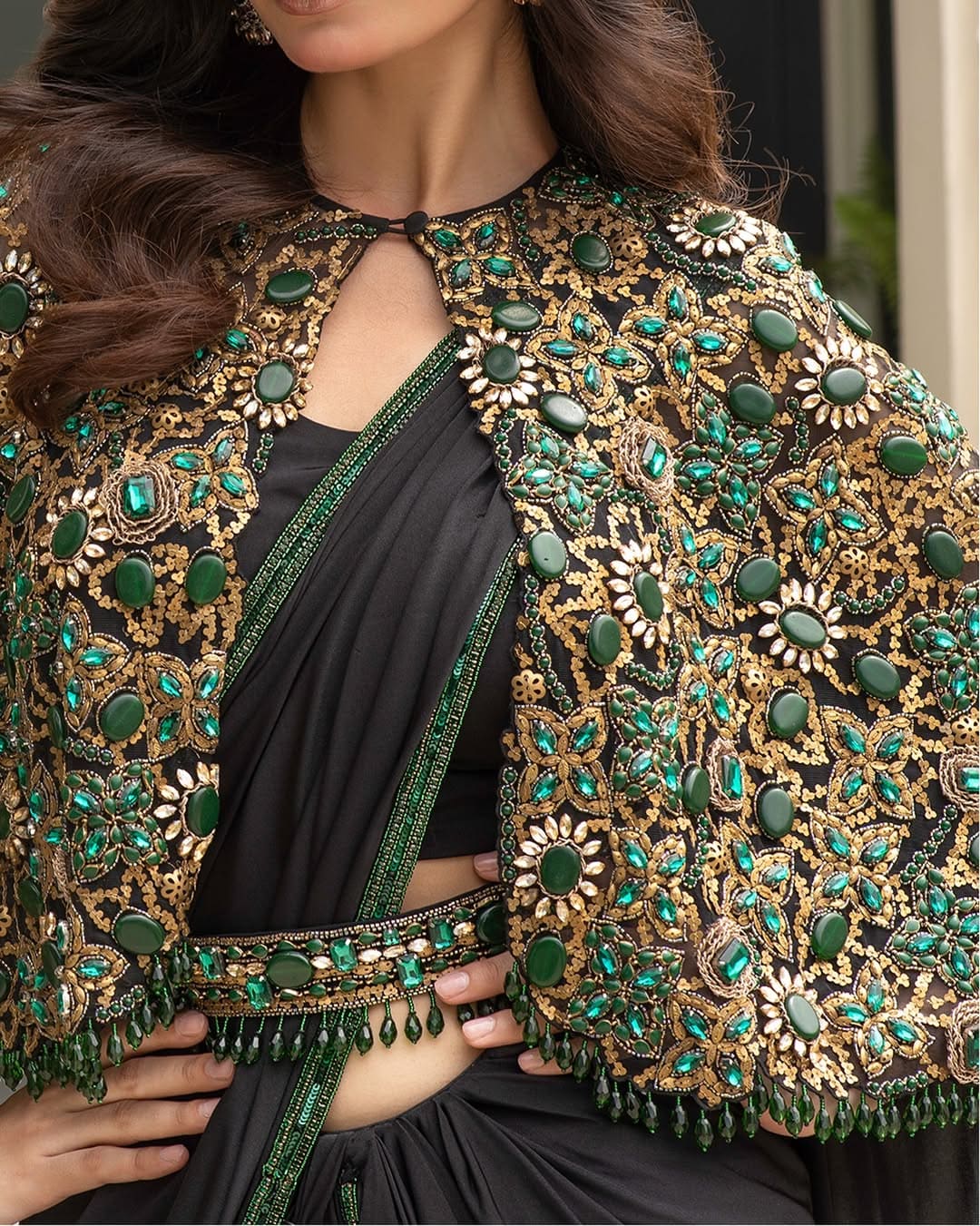
Color is broadly open here. The sangeet is the least traditional of the ceremonies and photographs constantly, usually on phones with flash, so tonal metallics and saturated jewel shades both hold up. The Deep Red Pre-Draped Saree is cut for exactly this kind of night, and the Emerald Green Beaded Jacket Set gives you the same coverage with a knot skirt.
There is a longer piece on this: sangeet outfit ideas by role, including what the bride's sister and the mothers should be thinking about.
The mehndi and the haldi: daytime, seated, hands busy
The mehndi is usually a daytime event, often outdoors, and you will be seated for a long stretch while henna dries. In the UK and the US, though, and particularly in Pakistani and Punjabi families, it frequently runs into the evening and is frequently merged with the sangeet into a single night. If yours is merged, treat it as a sangeet and read the piece linked above instead.
For a daytime mehndi, three practical rules follow.
Keep sleeves short or push-up, because henna is applied to hands and forearms and long fitted sleeves are a genuine problem. Choose fabric that does not crush, since you will be on floor cushions or garden seating for hours. And go softer in color than you would after dark, because daylight flattens deep jewel tones and lifts pastels, yellows and greens. If your mehndi is an evening event, invert that last one: under phone flash, saturated color and metallics photograph far better than pastels do.
The haldi, where the families have one, is the function with the clearest instruction of the weekend. Turmeric is thrown, smeared and rubbed in, and it does not come out. Wear something you would genuinely be happy to retire, and expect the palette to be yellow and marigold throughout.
That palette is also why The Kaftans Collective suits the mehndi so well: quiet embellishment, nothing that needs managing, comfortable seated. The Yellow Silk Chiffon Pearl and Crystal Kaftan sits inside the traditional mehndi yellow rather than beside it, which is why it reads as knowing the occasion rather than trying too hard. Save it for the mehndi; the haldi is not the day for anything you want to keep. The Mehndi and Sangeet Edit gathers the color-forward pieces for both nights.
The ceremony: the most traditional hour
The ceremony is the one time a guest should read the room conservatively. A saree or a lehenga, floor length, silk or georgette rather than sheer. Jewel tones, warm neutrals and gold work all belong here.
Two colors are worth a moment's thought, and the answer depends on the tradition rather than on the hour.
White is the one to think twice about across the whole weekend. In many North Indian traditions it carries a mourning association, and at a Christian or fusion ceremony it competes directly with the bride. South Indian weddings are the clear exception, Kerala above all, where off-white with a gold border is the celebratory choice for guests as much as for the bride.
Red is the bridal palette at most Hindu ceremonies, so leave a full red drape to the bride on the wedding day itself. At a Sikh, Muslim or Christian Indian ceremony that convention reads differently. Both colors get easier at the reception. If you are unsure which convention your invitation follows, ask.
The designer saree collection is built around this part of the weekend. The Champagne Shimmer Saree is a good example of the register: present, embellished, not louder than the couple.
Two pieces for the ceremony hour


The reception: the top of your register
The reception is the dressiest event of the weekend and the only one where you can go fully to the top of your register. It is almost always a hotel ballroom or a banquet hall, which means hard lighting and constant photography. Hand set embellishment catches that light and keeps its depth in photographs, while flat printed fabric tends to disappear.
This is where a cape saree, a structured cape set or a heavily worked wedding guest saree belongs. The Black Crystal and Sequin Cape Saree is a reception piece in the truest sense: black is entirely correct at an evening reception in the US, UK and Gulf, and the cape carries the weight the room expects.
If you want one piece to cover both the ceremony and the reception, choose the reception piece and dress it down. The reverse rarely does.
Two pieces for the reception


If you cannot drape a saree, you have two easy answers
Not being able to drape a saree is not a beginner's problem. Second and third-generation South Asian women say the same thing openly, and the fear underneath it is specific: a wardrobe malfunction, in photographs, in front of people who would have got it right. Two garments remove it. If the words themselves still blur together, a quick primer settles what a saree, a kaftan and a lehenga each actually are before you choose: saree vs kaftan vs lehenga, explained.
A pre-draped saree. The pleats and the pallu are stitched and set in the atelier: two pins and you're done, and nothing needs re-pinning during the evening. You step into it and fasten it, and it looks exactly like a traditional saree because it is one. The ready to wear sarees are built for this, and the Deep Red Pre-Draped Saree shows the construction. It is the best single answer for a first-time guest who wants the saree silhouette without the technical risk. For the ceremony hour, pick one of the covered, non-sheer drapes in that collection rather than a corset, off-shoulder or one-shoulder style.
A kaftan. A kaftan asks nothing of you at all. No draping, no blouse size to guess at, no pinning, generous coverage, and comfortable if you will be seated on floor cushions for hours at a mehndi or a dholki. It layers beautifully with statement jewelry, which is where the drama comes from. The Kaftans Collective covers the range, and the Yellow Silk Chiffon Pearl and Crystal Kaftan sits inside the traditional mehndi yellow rather than beside it.
Almost every guide sends first-time guests to a lehenga, and that is honest advice, because a lehenga is a skirt, a blouse and a dupatta and it is easy to wear. We do not make lehengas and we will not pretend otherwise, so if a lehenga is what you want, buy one. If what you actually want is the thing behind that recommendation, a South Asian outfit you can put on unaided and be certain of all night, a pre-draped saree or a kaftan gets you there with less to manage and a better fit. The blouse is made to your measurements, so there is no size chart to gamble on.
One outfit that comes back out of the wardrobe
A South Asian wedding is rarely one event. Three days of functions is three outfits, and the next invitation usually arrives before the year is out. A piece that is made to your measurements earns its place across a season: restyled with a different blouse, worn to the next reception, kept.
Rashmi Kumari pieces start from $530, are hand made to your measurements, and are yours to restyle across a season. Because each piece is cut to your measurements, orders are final sale; our stylist takes you through the measurements on WhatsApp before anything is cut.
How far ahead to order
Every piece is cut and hand embellished after you order it, in our UAE atelier, over 4 to 6 weeks. That is what makes it yours: your measurements, then blouse style, sleeve length, drape and color on a saree, or sleeve length and embellishment on a kaftan or a set.
- 8 to 10 weeks out is the house recommendation: 4 to 6 weeks of making, then 2 to 5 business days by tracked express courier.
- 12 weeks out is comfortable if your date could move.
- Under 6 weeks, message the concierge on WhatsApp with your date before you choose a piece.
Shipping is a flat $45 to anywhere in the world. India is served on its own shipping terms, so message the concierge for those. The worldwide delivery page sets out making time, transit and duties for the cities our clients live in.
Dressing for a US, UK or Gulf wedding season
Diaspora weddings have their own constraints and they are rarely discussed.
Winter weddings in the US and UK. A December reception in Chicago, Boston or Manchester means you will cross a car park in whatever you are wearing. Choose weight over sheer: heavier georgette, a cape that doubles as a layer, a jacket set with real sleeves. A long cape set solves the problem that a shawl over a sleeveless blouse only partly solves.
Ballroom weddings in the Gulf. Venues in Dubai, Doha and Riyadh are heavily air conditioned and the ceremony to reception gap can run for hours. Lighter fabric with more embellishment is the correct trade there, not more fabric.
Coverage. For a wedding in Saudi Arabia or a conservative family gathering anywhere, a high collar, full sleeves or a long jacket set is the difference between comfortable and self conscious all evening. Ask before you assume.
Repeat wearing. Diaspora wedding seasons run back to back, often several functions in one week, and the same guests attend all of them. A piece that changes with the blouse, the jewelry or the drape earns its place. Anything that only works once is a harder purchase to justify.

Frequently asked questions
Can I wear a saree if I'm not Indian?
Yes. Wearing a saree to a South Asian wedding you have been invited to is read as respect and participation, and hosts are consistently delighted when guests do it. It becomes appropriation only when a garment is worn as a costume or a joke, which is the opposite of what you are doing. Buy a properly made saree and ask someone in the family if you want help putting it on.
What should a westerner wear to an Indian wedding?
Dress the ceremony rather than the venue. For the wedding ceremony wear a floor-length saree in a jewel tone, a warm neutral or gold work, with shoulders covered; for the sangeet wear something you can dance in, such as a pre-draped saree or a cape set; for the reception go to the top of your register, because it is the dressiest event of the weekend. If you cannot drape a saree, a pre-draped saree or a kaftan gives you the same look with nothing to manage.
What colors should you not wear to an Indian wedding?
At a North Indian Hindu wedding, avoid white and black at the ceremony and leave full bridal red to the bride. At a Kerala wedding those rules do not apply and cream with a gold border is celebratory, but elsewhere in South India, in Tamil, Telugu and Kannadiga families, red, maroon and mustard silks hold and plain white is still avoided. At a Pakistani Muslim wedding, avoid all-white and all-black and lean into green and jewel tones. At a Christian Indian wedding white belongs to the bride and the rest of the palette is open. The only universal rule is that you should not outshine the bride, so ask the couple what she is wearing and go a clear step away from it.
Can you wear black to an Indian wedding?
At an evening reception, yes. Black is standard at diaspora receptions in the US, UK and Gulf and reads as formal rather than somber. Some traditional North Indian and Pakistani families still avoid black at the daytime ceremony, so if you are unsure, wear it after dark.
Can you wear white to an Indian wedding?
It depends whose traditions the day follows. In many North Indian and Pakistani families white carries a mourning association, and at a Christian or fusion ceremony it competes with the bride, so it is the one shade to think twice about. South Indian weddings are the clear exception, Kerala above all, where off-white with a gold border is celebratory and is worn by guests as readily as by the bride. If you do not know which applies, ask the couple.
How long does a made-to-order outfit take to arrive?
Each piece is hand made to order in our UAE atelier in 4 to 6 weeks, then shipped by tracked express courier in 2 to 5 business days. Shipping is a flat $45 worldwide, and India is served on its own shipping terms. Order 8 to 10 weeks before the date, and customization is included at no extra charge.
See the cocktail and wedding guest sarees, or the pre-draped sarees if you would rather not drape anything. Send the concierge your event date on WhatsApp and we will tell you honestly whether it lands.
Is customization included, or does it cost extra?
It is included, at no extra charge. Because each piece is cut and hand embellished after you order it, we work from your measurements rather than a size chart, and someone walks you through taking them. On a saree you also set the blouse style, sleeve length, drape and color; on a kaftan or a set, the sleeve length, color and embellishment. Choose Customize on any product page, or message the concierge on WhatsApp, where a video consultation with the stylist is available on request.
Will I pay customs on an outfit shipped to the US or UK?
Import duties and VAT, where they apply, are payable on delivery. For the US, duties currently apply from the first dollar because the low-value exemption was suspended in 2025; for the UK, import VAT and duty are usual. Ask the concierge on WhatsApp and we will estimate the landed cost for your country before you order.
Every piece is made to order, and being made to your measurements is included in the price. See the cocktail and wedding guest sarees, or send the concierge your event date on WhatsApp.