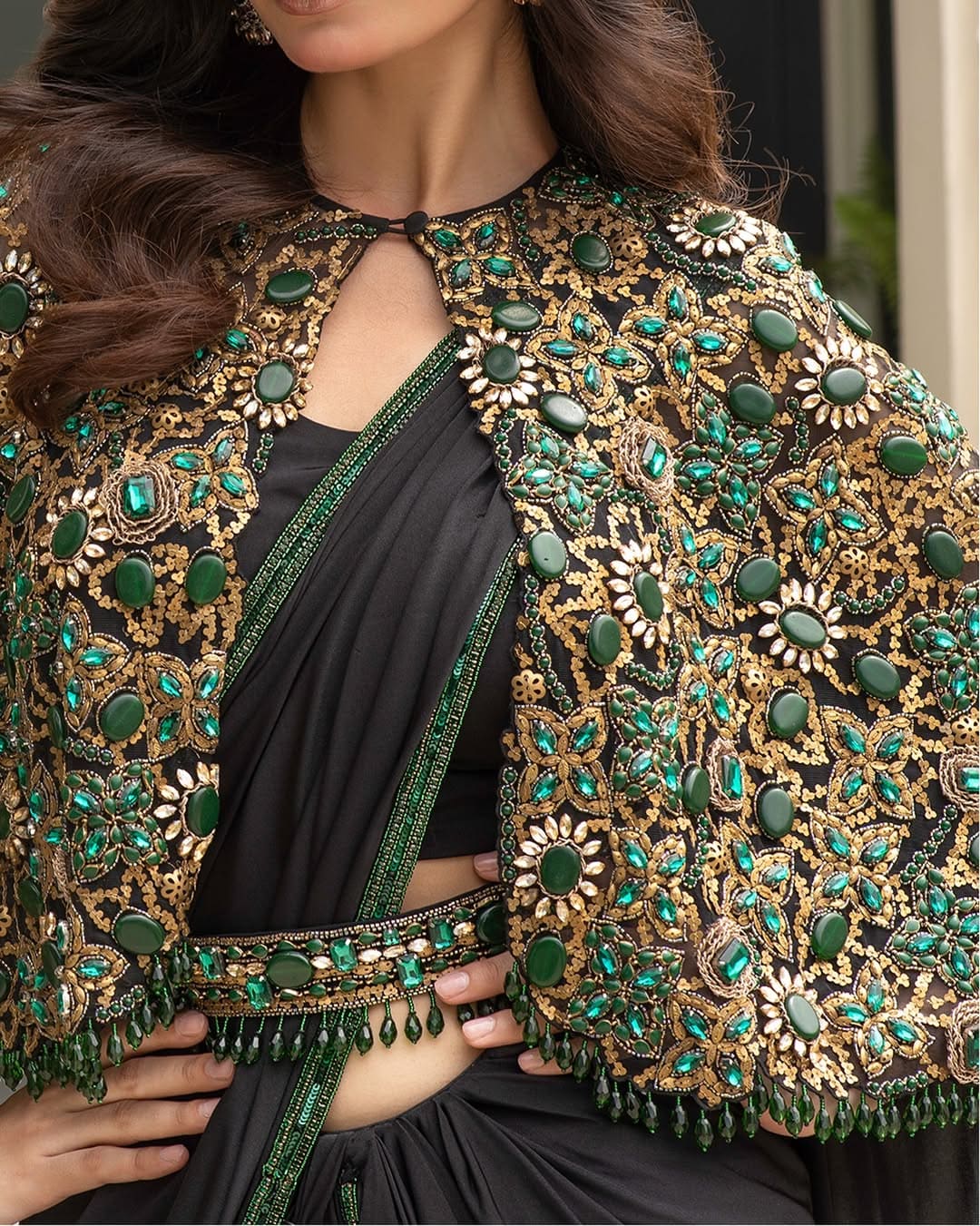

Dress for Diwali the way you would dress for any long evening that ends up somewhere warm and crowded: something you can eat in, sit on the floor in, and be photographed in under low light. Go a full step brighter and shinier than you would for a normal dinner, because this is the one night of the year when a room is lit by actual flame and a metallic reads as elegant rather than loud. Deep jewel shades and real metal work both hold up. Pale matte fabrics do not. And unlike a wedding, nobody in the room owns a color, so the palette is far more open than at a wedding.

Diwali is not one occasion, and it is not one tradition
Two things make this harder to Google than it should be.
The first is that Diwali is observed by Hindu families, by Sikh families who mark Bandi Chhor Divas on the same nights, and by Jain communities, and the number of days, the customs and the dress conventions vary between them, between regions, and from one household to the next. This is a guide to getting dressed, not a guide to the festival. Where the two come apart, follow your hosts.
The second is that "what to wear for Diwali" is really three different questions, and most of the advice online answers only the loudest one. A party at somebody's home or a hired venue, a quieter gathering at a relative's house, and the celebration your office puts on are three different rooms with three different registers. Each gets its own section below.
Dressing for light rather than for a dress code
Diwali light is a genuinely different problem from venue light, and it is the most useful thing to understand before you choose anything.
A room lit by diyas and candles has a warm, low, moving light source sitting at floor level and on every ledge, which is close to the opposite of a ballroom's flat overhead wash. Two things behave beautifully in it. Anything with a reflective surface, which means real metal thread, sequins, foil work and mirrors, catches a flame and throws it back, and because a flame moves, so does the catch. And deep saturated shades keep their identity where pale matte ones simply go flat.
Gold is the obvious answer and it is obvious for a good reason. Antique gold, bronze and rose gold all do the same job with less glare than a bright polished metallic, which matters if you are sitting close to a light source for hours. The house drapes are gathered in Six Yards of Grace, which is the fastest way to see the range in one place. The Gold Lace Butterfly Sleeve Saree and the Deep Blue Molten Gold Foil Saree are two versions of the same idea, one where the gold is the whole garment and one where it moves across a jewel base.
Mirrorwork deserves its own mention here because it is the technique flame was made for. The Crimson Mirrorwork Saree does something in candlelight that no photograph of it on a white studio background can show you. It sits with the rest of the red sarees, which is the deepest color group in the house.
Then the difference from every wedding guide you have read: there is no bride in the room. At a wedding, half your color decision is really a decision about what you must not wear. At Diwali nobody is holding a color, which removes the hardest constraint in South Asian occasion dressing and leaves you with a much better question, which is simply what looks good in the light you will be standing in. If you want the version of that question with a bride in it, the wedding guest guide works through it ceremony by ceremony.
One caveat worth carrying. Some families keep to bright shades at festive gatherings and would rather not see black at one. It is not a universal rule and plenty of households do not think about it at all, but if you are going to somebody's home for the first time it costs one message to ask, and asking always reads well.
Two pieces built for this light


A Diwali party
This is the loudest room and the one most people are actually searching for. An evening event, at a hired venue or somebody's home, food circulating for hours, music, and a phone camera pointed at you roughly every four minutes.
Go to the top of your register. This is a night for a full metallic, a heavily worked drape or a structured set, and it is the single best occasion in the calendar for a piece that would be slightly too much at a dinner. The cocktail sarees are edited for exactly this kind of evening, and the Bronze and Antique Gold Embroidered Pant Set is the version with trousers, which is worth remembering if the party moves outdoors for fireworks.
If the invitation says a saree and you would rather not manage one across a long night, the ready to wear sarees give you the silhouette already set. The Emerald Green Beaded One-Piece Saree is the clearest example: jewel base, beadwork that catches light, and nothing to re-pin.
Two pieces for the party


A puja at home
A quieter room, and a more traditional one. Expect to be seated, very possibly on the floor, expect your shoes to come off at the door, and expect to be closer to open flame than at any other point in the weekend.
The register drops one notch and coverage goes up one. A kaftan is close to perfect here, which is why The Kaftans Collective is the first place to look for this particular room: full length, uncomplicated to sit in, nothing that needs holding, and quiet embellishment that still reads as dressed. The Silk Satin Twist Kaftan with Antique Gold Embroidery sits exactly in that register, and the Burnt Orange Gold-Embroidered Kaftan brings the marigold end of the palette without any effort.
If you would rather be in a saree, choose one you can fold your legs in and one whose pallu stays put without a hand on it. That is a construction question more than a fabric one, and it is the same answer as the one in the sangeet guide: a stitched or pre-set drape solves it and a wrapped six yards does not.
The office Diwali
The hardest of the three to get right, because two dress codes are running at once and neither is written down.
The workable read is festive above the waist and ordinary below it. A worked jacket, a cape or an embellished top over trousers reads as celebrating without committing you to floor length in a building with lifts and a lunch queue. The cape and jacket sets are the natural place for this, and a jacket set is also the only thing on this page you will genuinely wear again to a work dinner months later.
Keep the shine to one element rather than three. In daylight and office lighting, the metallics that behave so well by candle flame turn into the loudest thing on the floor, and a single worked jacket over plain trousers is a much better read than a full metallic under fluorescent tubes.
What actually works around diyas and a full table
The practical notes, ranked by how often each one catches somebody out. None of these appear in a normal outfit guide and all of them come from the room rather than the lookbook.
- Open flame is at your height and at your hem. Diyas sit on the floor, on stairs and along ledges, and candles cover every flat surface. A wide flowing sleeve, a trailing pallu and a dupatta carried in one hand all pass through the same air as a live flame at some point in the evening. Secured beats loose on this one night, which is an argument for a stitched drape, a fitted sleeve or a cape over a scarf you have to hold.
- Fine net and tulle near sparklers. If the evening moves outside for fireworks, that is the moment to put a jacket or a heavier layer over the top. It is also, separately, the moment you will be glad of the layer, because the temperature drops.
- Floor seating. Many homes seat guests on the floor for at least part of the night. Trousers and a stitched drape both fold comfortably. A narrow pencil skirt does not, and you will know within ten minutes.
- Bare feet on stone. Shoes come off at the door in most homes, so whatever you wear needs to work at your barefoot height as well as in heels. This is the single most common reason a floor length piece ends up being carried.
- You will be eating with your hands. Mithai, a thali, a plate balanced on your knee. Sleeves that push up, or sleeves that stop short, are worth more than any other detail on the garment that night.

Order by these dates for Diwali 2026
Diwali 2026 falls on Sunday 8 November. Every Rashmi Kumari piece is made after you order it, over four to six weeks of atelier work, and then has to travel, so the calendar does the deciding.
| Order by | Who this is for | What happens |
|---|---|---|
| Sunday 6 September 2026 | anywhere in the world | Nine weeks. Comfortable. Room for the measurement conversation, the making, the courier and a fitting adjustment if you want one. This is the date to aim at. |
| Sunday 20 September 2026 | United States and United Kingdom | The outside date for a made-to-order piece. Four to six weeks of making, then a tracked express courier, lands it in the week of Diwali with nothing to spare. |
| Wednesday 23 September 2026 | inside the UAE | Transit is a day or two rather than a week, so the local cutoff sits later, but not by much: this leaves two to three days of slack, not a comfortable buffer. |
| After 20 September (US and UK) or 23 September (UAE) | everyone | Ask about a standard size instead. See below. |
After the cutoff. The house offers standard sizes in S, M and L on most styles, which takes the measurement stage out of the process entirely. Whether a given piece can reach you before the eighth of November depends on the piece, so put your date in front of the concierge on WhatsApp before you settle on something. You will get a straight answer rather than a hopeful one, which is worth more in the last three weeks than any amount of optimism.
If you are reading this in October, you have probably missed the made-to-order window for this year and it is better to say so than to sell around it. Two useful things follow anyway. The wedding season that runs through the winter in the US and the UK starts more or less where Diwali ends, and every piece recommended above belongs at those evenings too, so ordering now for the next occasion is the sensible move rather than the consolation one. And putting the date in the calendar for next August is the whole trick: the people who get this right are simply the ones who started earlier.
Navratri, for anyone dressing for those nights instead, runs from 11 to 19 October in 2026, with Dussehra following on the 20th. An order placed now does not comfortably make the very first night: the same nothing-to-spare arithmetic as the US/UK Diwali row puts that cutoff at 23 August, already behind us. But it does still reach the back half of the festival. Six weeks of atelier work plus transit lands in the first half of October, which is inside the window for most of its nine nights. If Navratri is the occasion and the date matters, ask the concierge for a timeline against the specific night rather than assuming the window is closed altogether.
Delivery is a flat forty-five dollars anywhere in the world, and worldwide delivery sets out the making window, the courier timings and the duties position city by city.
Two pieces to order now


Frequently asked questions
What should you wear to a Diwali party?
Something festive enough to photograph well in low light and comfortable enough to last a long evening of food and standing. A worked saree, a cape or jacket set, a pant set or a full-length kaftan all suit the night. Aim a step brighter and shinier than you would for a normal dinner, keep flowing sleeves and loose scarves away from candles and diyas, and remember your shoes are likely coming off at the door.
What colors work best for Diwali?
Gold, in every register from bright to antique, and deep saturated jewel shades: emerald, crimson, deep blue, aubergine, bronze. The reason here is the light rather than any rule about color. Rooms lit by flame have a warm, low, moving light source, so metal thread, sequins, foil and mirrorwork catch it and throw it back, while pale matte fabric flattens out. Unlike a wedding there is no bride whose color you need to avoid, so the palette is much more open than at a wedding, with one small caveat about black covered below.
Is there anything to avoid wearing at Diwali?
Two things, and only one of them is about color. Practically, keep wide flowing sleeves, a trailing pallu and any scarf you have to hold in one hand clear of open flames, and put a layer over fine net or tulle if the evening moves outside for fireworks. On color, some families prefer to keep festive gatherings to bright shades and would rather not see black at one. It is far from universal, so if you are visiting a home for the first time, a quick message to your host settles it.
How far ahead do I need to order an outfit for Diwali?
Roughly seven to nine weeks, and at least seven. Each piece is made after you order it, which needs four to six weeks of atelier time, and then it has to travel: a few business days to the United States, slightly fewer to the United Kingdom, a day or two inside the UAE. The exact order-by dates for this year are in the block above. If you are later than that, ask about a standard size in S, M or L, which removes the measurement stage.
Can I have a Diwali piece made to my measurements in time?
If you are inside the ordering window above, yes, and it costs nothing extra. Rashmi Kumari includes customization at no additional charge, so a piece built to your measurements is the same price as ordering the standard size, and you can also set the color and the embellishment, plus the blouse style, sleeve length and drape on a saree. Send the concierge your date first and choose the piece second. That order of operations is what makes the difference when the date is close.
Everything on this page is made after somebody orders it, which is why it can be built to your measurements at no additional charge rather than bought off a rack. See The Kaftans Collective for the evenings at home, or the cocktail sarees for the party, and tell the concierge your date before you choose the piece.